

Chinese Medical Manuscripts

The Unschuld Collection at the Staatsbibliothek zu Berlin

In 2012, the Staatsbibliothek zu Berlin had the opportunity to purchase the larger part – 823 volumes – of an exceptional collection of Chinese medical manuscripts. The collection had been gathered over a period of more than four decades by the renowned historian of Chinese medicine and pharmacology, Paul U. Unschuld, together with his wife Ulrike Unschuld. In the same year, when Paul U. Unschuld and Zheng Jinsheng published their three-volume catalogue and introduction to the collection, a detailed guide to explore this treasure trove became available to researchers. In 2016, a further 130 manuscripts on human medicine as well as 32 manuscripts on veterinary medicine were added to the Unschuld collection. A supplement to the 2012 catalogue with descriptions of most of the non-veterinary manuscripts was recently published. To make the collection even more accessible, the basic metadata and keywords of all catalogued titles were incorporated into the East Asia Department’s online catalogue, where they can be searched for directly via shelfmark (Slg. Unschuld*).

Over 880 of the overall 985 manuscripts have already been digitized and are available to explore in the Digitized Collections portal of the Staatsbibliothek zu Berlin. User requests via CrossAsia’s Digitization on Demand (DoD) service are further expanding the digital surrogates of the collection.

Inspection of the original manuscripts is possible in the East Asia/Orient Reading Room. Volumes can be ordered via the online catalogue, preferably a day in advance. In order to enter the library and place orders, a library card of the Staatsbibliothek zu Berlin is required.

Numbers
985 titles
885 titles digitized (08.2026)

Shelfmarks
Slg. Unschuld 8001 – 8823
Slg. Unschuld 8831 – 8960
Slg. Unschuld 8963 – 8994

Search
CrossAsia Suche (Slg. Unschuld*)
Digital Collection (“Slg. Unschuld”)

Printed Catalogues
Unschuld, Paul U. & ZHENG Jinsheng (eds.),
Chinese Traditional Healing: The Berlin Collections of Manuscript Volumes from the 16th through the early 20th Century. Leiden: Brill 2012 (3 vols.)
OLS Bb OA chin 50-1/3 Online Version

Unschuld, Paul U. & ZHENG Jinsheng (eds.),
Chinese Traditional Healing: Continued. Leiden: Brill, 2025. Online Version

The Collection

Paul U. Unschuld

Prof. Paul U. Unschuld (source: Horst-Görtz-Institut)

Ulrike Unschuld

Dr. Ulrike Unschuld (source: private)

Collection History

Paul U. Unschuld held a chair in the Department of the History of Medicine at LMU Munich from 1986 to 2006. As a professor emeritus, he established the Horst-Görtz-Institute for the Theory, History and Ethics of Chinese Life Sciences. From their very first visits to the People’s Republic of China, Unschuld and his wife, Dr. Ulrike Unschuld, collected medical manuscripts, recipe collections and scribbled notes written by practitioners. These were not sold in rare book shops frequented by bibliophiles, but rather at roadside flea markets.

Until recently, hardly any Chinese library collected these kinds of manuscripts. They flourished outside the elite print market and were mostly written for personal use. The Unschuld collection is exceptional in providing insights into the actual practices of Chinese healers, doctors and apothecaries, as well as the healthcare of common people.

Contents

Approximately one third of the manuscripts contain excerpts from printed books. Rather than constituting full copies of any published text, the manuscripts reflect what was considered most useful for everyday practice. Unschuld and Zheng identify the dominance of recipes as proof that most of the manuscripts were used privately by lay people. Other prominent topics include the treatment of children and women, diagnosis, invocations and spells, acupuncture, and materia medica.

Many manuscripts are written in clumsy characters on cheap, coarse straw paper with only a rudimentary binding made of twisted paper spills; others have elaborate colored drawings and are written in a neat hand on quality paper. Whereas the bulk of the manuscripts date to the 19th and early 20th century, the collection also includes manuscripts from the 16th century (for example 小兒推拿秘訹, Slg. Unschuld 8567) and some with unique texts that never got printed (for example 秘傳喉科, Slg. Unschuld 8101).

Provenance

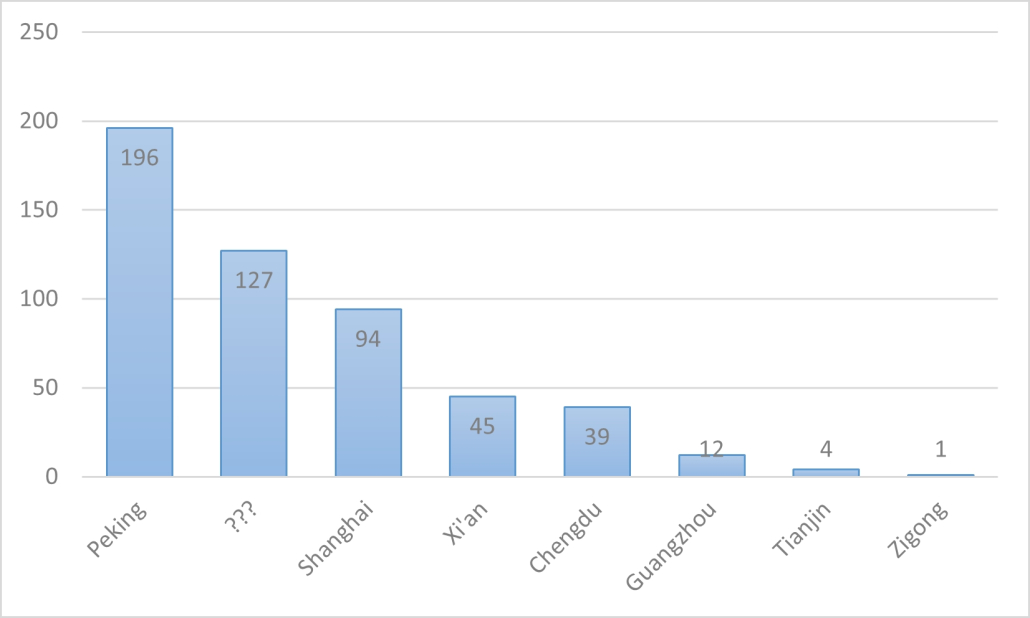
Recent research has shed further light on the provenance of the Unschuld manuscripts in the collection of the Staatsbibliothek zu Berlin. By synthesizing data retrieved from Paul U. Unschuld’s unpublished acquisition notes and archival sources in particular, information could be obtained on the time and/or place of acquisition for more than half of the manuscripts in the collection (see the online dataset). Statistical analysis showed that the majority of manuscripts were acquired in Beijing and Shanghai, but significant numbers also derive from other places, such as Xi’an, Chengdu, and Guangzhou (see the accompanying research paper).

Selected Topics

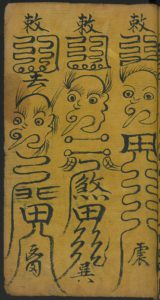
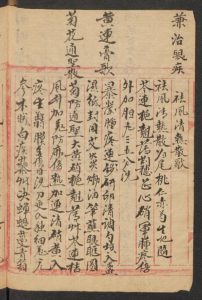
Chinese Medical Manuscripts 祝由書 (Slg. Unschuld 8650)

祝由書 (Slg. Unschuld 8650)

Healing with Magic & Dispelling Demons

Human rationality is often unable to grasp the reasons for an outbreak (or the overcoming) of a disease, which seem to follow no fixed pattern. This is reflected in the Unschuld collection, which contains a considerable number of manuscripts dedicated to spells, invocations, and magical charms. Many of these also depict the demons, which are believed to cause specific illnesses. According to the introductory essay in the Unschuld and Zheng catalogue, at least 47 manuscripts fall into this category.

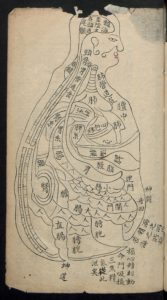
Chinese Medical Manuscripts 針灸擇要 (Slg. Unschuld 8566)

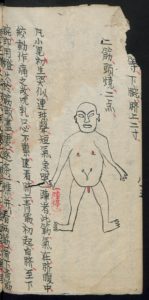
秘傳推拿妙訣 (Slg. Unschuld 8349)

Anatomy & Acupuncture

The inner landscape of the human body and the position and shape of its organs were integral to Chinese medical knowledge. In contrast to practices in Western medicine, Chinese healers mainly attempted to regulate this intricate system of interdependencies through prescriptions, massages, spells and acupuncture. The Unschuld collection contains at least 39 manuscripts on acupuncture, cauterization and similar techniques; images of anatomy most frequently appear in treatises on basic theory (19 manuscripts).

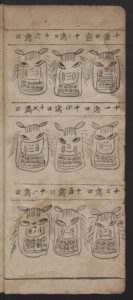
Chinese Medical Manuscripts 小兒各種驚圖 (Slg. Unschuld 8439)

小兒各種驚圖
(Slg. Unschuld 8439)

Women & Children

The Unschuld collection contains medical manuscripts covering a wide range of medical disciplines, including medicine related to women (52 manuscripts), children (85 manuscripts), eyes (28 manuscripts) and wounds (10 manuscripts), among others. As these numbers suggest, ensuring the health of offspring was an important medical issue and a lucrative business for apothecaries and healers.

Chinese Medical Manuscripts 各科藥方 (Slg. Unschuld 8334)

各科藥方 (Slg. Unschuld 8334)

Recipes

Concoctions, powders, pastes and pills – pharmaceutical remedies for ailments are a major part of the medical practices of ordinary Chinese people. This focus is also apparent in the Unschuld collection: more than 300 of the manuscripts constitute recipe collections or at least contain some recipes. Unschuld and Zheng have counted 52,490 recipes in the 881 manuscripts described in their 2012 catalogue.

Chinese horse medicine

纂圖元亨療馬集 6 卷 (存2卷)
(Slg. Unschuld 8963)

Veterinary Medicine

In 2016, the Staatsbibliothek zu Berlin acquired a set of 32 manuscripts related to veterinary medicine. Most of the manuscripts focus on horses, with many of them showing a relationship to the Yuan Heng Liao ma ji 元亨療馬集 (as the manuscript depicted here). Other manuscripts in this segment of the Unschuld or Unschuld/Ramey collection assemble veterinary recipes and provide diagnostic guidance. The Digitized Collections of the Staatsbibliothek zu Berlin contain two editions of the Yuan Heng Liao ma ji, one published by the Sanyi tang 三義堂 in 1889 (shelfmark Slg. Unschuld 8961), one published in the early 19th century as a “reprint” (so-called fangke ben 仿刻本) of a 1736 print (shelfmark 445883-1/6).

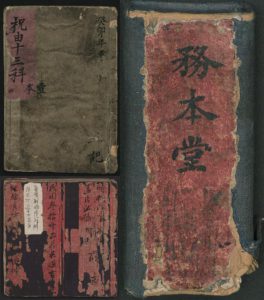
Various book cover

Paper, Bindings, Formats

Most of the manuscripts in this collection consist of lower-quality paper, mostly made from bamboo pulp and sometimes from durable rice straw (for example 藥性歌括, Slg. Unschuld 8214). The paper sheets are often bound together with thread by side-stitching through four or more holes close to the spine, a method commonly seen in premodern books throughout East Asia. Occasionally, only a “preliminary” binding was used, consisting of simple paper spills, twisted and threaded through holes in the book block. While the East Asian codex is the most common book form encountered in this collection, there are also around two dozen leporellos and nine scrolls (醫方卷子之一至之七, Slg. Unschuld 82558261; 符咒, Slg. Unschuld 8873-8874). These different book forms, as well as the variations in format – ranging from large volumes suitable for display to highly portable, small-size volumes – reflect the variety of purposes for which these manuscripts were used.

Further Sources

CrossAsia Talks

Manuscripts from the Unschuld collection have already been the subject of several lectures in the series „CrossAsia Talks“:


Comment Comment

Further Medical Texts

In addition to the Unschuld collection of Chinese medical manuscripts, the East Asia Department of the Staatsbibliothek zu Berlin holds numerous other sources related to the history of Chinese medicine. These are found in the old Libri sinici collection as original prints, and in facsimile reproduction published in the medical text section (子部 : 醫家類) of large reprint collections such as in the Wenyuange Siku quanshu 文淵閣四庫全書 (Shanghai, 2003; shelfmark 5 A 141803) and the Xuxiu Siku quanshu 續修四庫全書 : (Shanghai, 1995-2002; shelfmark 5 B 30000) as well as in specialized collections, such as the Zhongguo gu yiji zhengli congshu 中国古医籍整理丛书 (Beijing, 2015; individual shelfmarks).

A number of important medical works have been digitized in two large-scale digitization projects of the East Asia Department: SSG 6,25 Digital and the Berlin-Krakow Project. These can be accessed via the East Asia online catalogue (search for “SSG 6,25 Digital” or “Verlagerte Bestände digital Ostasiatica”). Some outstanding examples from the collection are:


Liu Wentai 劉文泰, Bencao pinhui jingyao ji  本草品彙精要 42 卷, 1505
::: Libri sin. Hirth Ms. 2

Ri, Jichin 李时珍, Bencao gangmu 本草綱目 52 巻, [京都] : 野田弥次右衛門寛永 14 [=1637]
::: Libri sin. 102/107 (from which the image above is taken)

Gong, Tingxian 龔廷賢, Wanbing huichun 萬病回春集 8卷 (early 17th c. print)
::: Libri sin. 83/84

Tang, Shenwei 唐慎微, Daguan bencao 大觀本草 30卷, 1579
::: Libri sin. 64/65

Wang, Kentang 王肯堂 (ed), Yitong zhengmai 醫統正脈 (contains 44 titles in 6 collections), 1601
::: Libri sin. 66/73


Of the above selection, Wanbing huichun is already listed as no. 17 in the earliest catalogue of Chinese books owned by the Kurfürstliche Bibliothek (Electoral library) (Hoei-van-pim-chun); the medical collection Yitong zhengmai 醫統正脈 shows several annotations in the handwriting of Christian Mentzel (1622-1701). Therefore, both books are among the earliest in the collection of the present-day Staatsbibliothek zu Berlin, which was founded in 1661.

Databases

The East Asia Department of the Staatsbibliothek zu Berlin not only holds the most comprehensive collection of printed materials in East Asian scripts, but also provides subscribed users affiliated with German academic institutions working on Asia with access to around 270 licensed databases via its CrossAsia service portal (crossasia.org).

Several of these databases contain traditional texts on various aspects of Chinese medicine, which can be accessed by authenticated users via their home computers. Most of the databases allow full-text searches, helping researchers to navigate the extensive traditional literature on topics such as Chinese medicine, concepts of health and illness, and the body. The most comprehensive collection of relevant works can be found in:


Apabi Ancient Books of Traditional Chinese Medicine 中医古籍库
::: The collection contains scanned images of 255 works in over 1,600 volumes, including rare prints and manuscripts. While bibliographical data and chapter headings are searchable, full text is not provided.

Scripta sinica 漢籍全文資料庫 (select 子部 : 醫家 from navigation tree)
::: The works transcribed for this database by the Institute of History and Philology at Academia Sinica in Taiwan are based on modern philological standard editions; therefore, punctuation is provided.

Jiben guji ku 中國基本古籍庫 (select 哲科庫 : 醫學類 in „category search“)
::: In this database of 10,000 works, about 280 are grouped under the label “medicine”. Works are provided in image and full text, and text searches (“keyword search”) can be confined to a category, such as “medicine” (醫學類).

Siku quanshu 四庫全書 and Xuxiu Siku quanshu 續修四庫書 (select 子部 : 醫家 from navigation tree)
::: These two famous, large collections have been digitized and now provide full texts and scanned images of approximately 3,500 and 5,400 traditional Chinese works, respectively. The former is an 18th-century project overseen by the Qianlong Emperor that compiled and transcribed (as well as censored) the original works. The latter was published by Shanghai guji chubanshe between 1995 and 2002 based on a national bibliographical project from the 1920s and reproduces published texts in facsimile. The Siku quanshu section on medicine contains 98 works, the Xuxiu Siku quanshu another 261 works.

A description in German of the Unschuld and Unschuld/Ramey collection was published on the CrossAsia Blog in June 2016.